

Freedom by Design? Controversial.
Inside our exhibition “Positions on Freedom. Design and Its Boundaries”

Dear reader,
It’s been a while! We are aware of that. But we come with an excuse. We weren’t lazy (even if being lazy is a revolutionary act under capitalism). In mid-May, we opened our first exhibition related to the thing Magazine at the Museum Angewandte Kunst (Museum of Applied Arts) in Frankfurt am Main. It is called “Positions on Freedom. Design and Its Boundaries,” and we want to use this edition of our newsletter to give you some insights and behind-the-scenes impressions of how this project came to be.
We hope you enjoy this little act of cultural self-advertisement.
Anton and Nina
Design, Freedom AND Democracy?!?
We like discussing the big topics. It is a good way to exemplify how design is connected to political and social aspects of life. You start with the meta level and work your way down to everyday life. That is pretty much the way we work as editors, but also as curators and exhibition makers.
The topic of freedom emerged in the wake of World Design Capital 2026 Frankfurt RheinMain, a title awarded by the World Design Organization every two years. Frankfurt received it for a concept that put the political dimension of design at its centre under the theme “Design for Democracy. Atmospheres for a Better Life”. In 2026, Frankfurt and the surrounding area are hosting over 400 related events, exhibitions, workshops, and more.
Our exhibition is one of these projects, and the topic it deals with was chosen in relation to the WDC’s theme. For democracies, freedom is a central concept. The German Basic Law (our constitution, if you will) mentions the term freedom 64 times, in various forms. However, it provides no definition explaining what freedom actually is and why it is important to democracies. The tricky thing about freedom is that you usually only sense it once it is taken away from you.
This high level of abstraction made freedom the perfect starting point for relating it to design, a discipline that is usually known for being very tangible and applied.
One Question, Multiple Answers
In order to deal with such a complex topic in a serious way, the method for doing so needs to be specific yet permeable. Finding a definition of freedom in relation to design that suits everyone seemed like an impossible task. That is why the title of the exhibition became its method, too. In total, 47 positions from different media and backgrounds tackle aspects of freedom in relation to design.
However, there is some theory behind the overall understanding of freedom within this exhibition. Very generally speaking, there are two types of freedom: negative and positive. While negative freedom describes the absence of obstacles, positive freedom describes the potentials that lie within humans and their actions. The philosopher Hannah Arendt further describes absolute freedom as something that only very few privileged people possess. For her, freedom is the next step after being liberated. While being liberated means the state granting you relative safety in your private sphere, being free means being able to participate in public life according to one’s own interests, and therefore in politics and discourse.
Following this understanding, the exhibition Positions on Freedom showcases a wide range of works that address questions of agency, whether enhanced or limited by design, for individuals and groups alike.


The Exhibition
The exhibition itself is conceived in three parts:
A group exhibition, fuelled by an open call and developed in cooperation with the museum, was curated by Vera Sacchetti and me, Anton Rahlwes. This section presents existing works by designers, researchers, architects, artists, and everything in between, who are in some way working on the relationship between freedom and design.
Three invited fellows were provided with a budget and all the components of the most-ordered USM Haller configuration (the main sponsor and partner of the exhibition) and asked to create a newly conceived position on freedom. The fellows were Mawuto Dotou, Fatma Cankaya, and Johanna Seelemann.
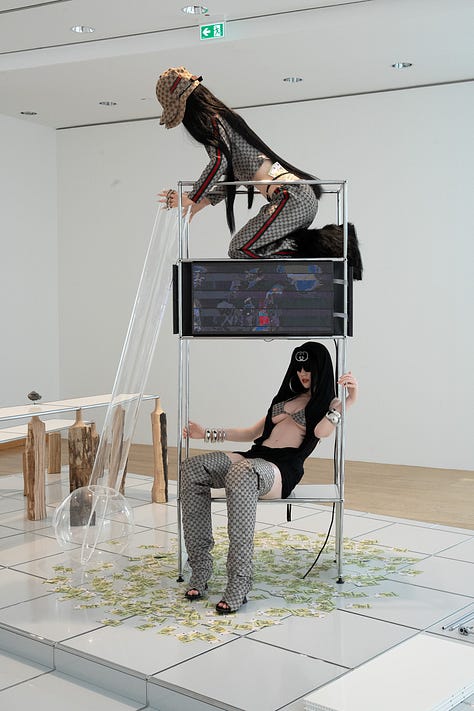
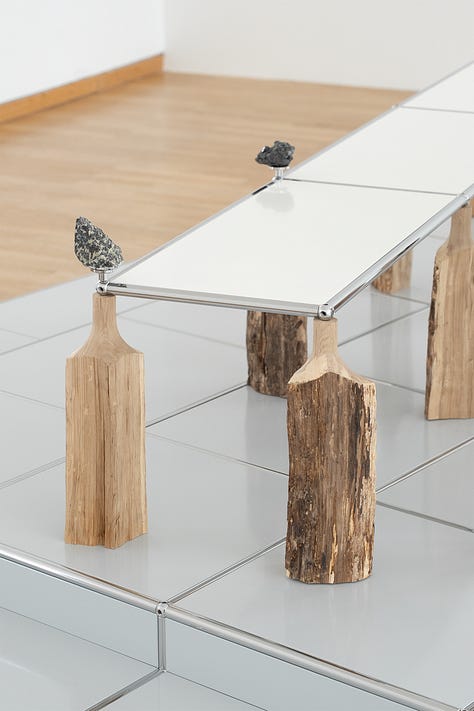
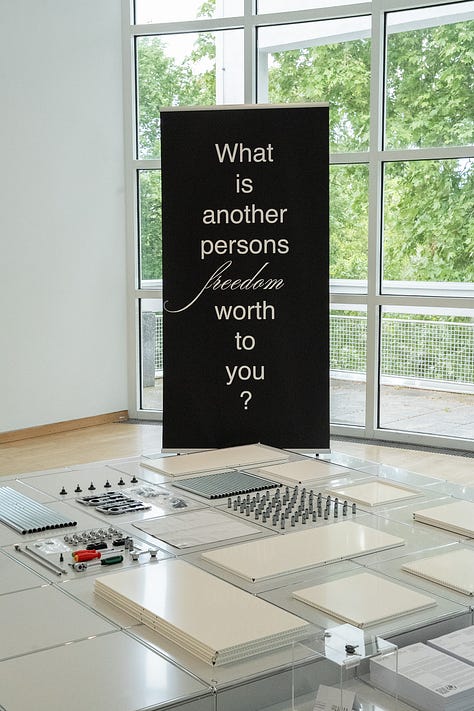
Fellows' works (l–r): Frankfurter Schrank, Semantic Extensions, Worth


Lastly, a reader (that can be purchased here) provides 14 texts on the topic, helping to expand the discourse in a written form that opens up perspectives different from those offered by applied works.
Even the scenography and graphic design were conceived as positions on freedom. Lotti and Anton Defant created architectural elements that structure the way visitors move through the space.
Autostrada Studios took the list as its main stylistic element, referencing the archival character of knowledge. They reinforced this idea through the use of Garamond, one of the oldest typefaces still in use today, whose origins can be traced back to the early days of letterpress printing.
A still-growing website featuring all exhibited works can be found here: the thing Fellowship.
But enough spoilers for now. If you are interested in the exhibition, it runs until 28 June.
I hope I was able to give you a sense of freedom (and design).
Anton