

Everything That’s Going Right with Design
Someone’s gotta be optimistic.

Dear Reader,
the thing Magazine is not necessarily known for being outspokenly optimistic about our beloved design discipline. However, we feel it’s time to move beyond simply jumping on the bandwagon of bleak future scenarios and instead highlight the many positive developments that have taken place over the past few years – within the creative fields, and the design scene in particular. This piece is not intended as a contrasting reply to Max Fraser’s article for Dezeen, “Everything That’s Going Wrong with Design,” but rather as an optimistic extension of it. While we do largely agree with Fraser’s observations, we wanted to build on them by shifting the focus toward possibility and change. We believe (and hope) that a sense of optimism and belief in positive transformation are essential for evolving the discipline.
Everything That’s Going Right with Design
This is an open list. Please feel free to add any additional points in the comments below. We are very curious to hear and read your thoughts.
Isms are being recognized.
Racism, classism, sexism (including homophobia and transphobia) are increasingly recognized as aspects that design reproduces – and by doing so, reinforces. It wasn’t that long ago (around 2018, when I started my career in design journalism) that only very few people in positions of power within design would even acknowledge that these structural issues exist at all, let alone that they affect not just individuals, but society as such.
The dominant modernist take used to be: Design is about function, and function is neutral. Today, we know better. There is no such thing as neutral design, and certainly no function that is universal to all humans.
Design is being taken seriously as a socio-political factor.
One example: In 2026, the German region of Frankfurt Rhein-Main will hold the title of World Design Capital. The overarching theme is Design for Democracy. This level of institutional visibility is clear proof of how far design discourse has come over the last years.
It shows that design is not a detached intellectual or purely aesthetic sphere, but a phenomenon that actively shapes people’s everyday lives. Whether one agrees with the title or format of having a World Design Capital or not, it signals that something is happening, something that frames design in a much wider context than it occupied throughout most of the 20th century.
Design is a fast-learning discipline.
Of course, design itself can’t learn – but designers can. And yes, there is plenty of room for improvement across many aspects of the field. Still, considering that design is a relatively young phenomenon (at least when linked to the term itself and its connection to industrialization), it has made remarkable progress in a short period of time.
Design is being applied while simultaneously questioning its own parameters, tools, and modes of operation. Especially when compared to longer-established disciplines like art or architecture (no shade – we’re all in this together), this ability to adapt and self-reflect is striking – which might be connected to the next point:
Design critically examines its own structures by (pun intended!) design.
Design is fluid. It can’t be summarized in a single sentence. What we called design fifty years ago is no longer the same today. While this constant transformation often leads to intergenerational conflicts, it can also be understood as a unique capability: the ability to shape systems while repeatedly questioning those very systems. Used wisely, this is an incredibly powerful trait.
The design scene is beginning to question what it looks like beyond capitalism.
The answers are still vague and often lack confidence. But who would have thought that a discipline whose origins are so closely tied to capitalism could become one of the more prominent forces questioning that very framework?
Craft, design, and art are slowly overcoming their ancient conflicts.
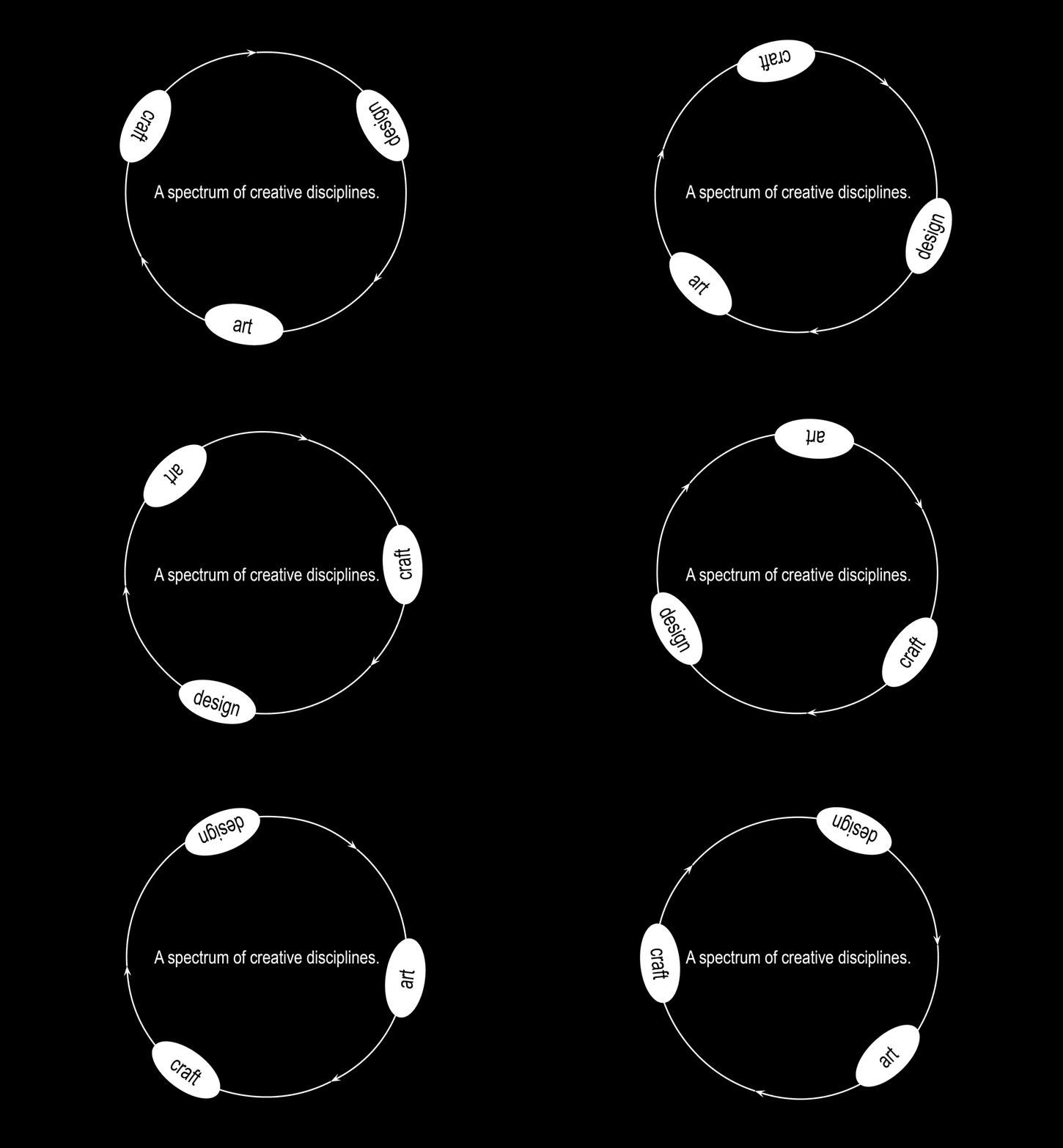
Slowly but surely, the old intellectual hierarchy – art first, then design, then craft – is crumbling. And everyone benefits from it. Much credit is due to decolonial discourses (and the people behind them), which have reopened and reintroduced understandings of aesthetic value that are not driven by modernist principles alone – principles that were often cold, abstract, and partly inhumane. So instead of thinking about creative disciplines in terms of hierarchies, why not imagine them as a spectrum?
Last but not least:
Design is joyful.
Why are humans drawn to design in the first place? It can’t be financial security. Even though design is deeply rooted in capitalism, it is rarely a discipline that makes people rich. For me personally, it was (and still is) its creative spark and aesthetic pleasure, which, at their best, emerge from imagining new perspectives on the world through human-made things, whether furniture, vehicles, apps, or concepts.
Design can shape the way we live together. Good design, in my view, always strives toward a more just world, helping to overcome inequalities, biases, and forms of destruction. This might sound boring, obvious, or idealistic, but in this sense, design becomes a powerful tool for applied discourse and collective imagination.
All these developments make me hopeful for a better future, with design playing a crucial role within it. This doesn’t mean that everything is fine. And it certainly doesn’t mean there isn’t still a great deal of work to be done (by work I mean the implementation of values, not work in a neoliberal sense).
What I am advocating for is a recognition of the immense potential embedded in the discipline of design, a discipline that serves as a vessel for two fundamental human traits: curiosity and creation. We “just” have to get our goals straight.
With optimistic greetings for the new year,
Anton
Further Browsing
Max Fraser’s article “Everything that’s going wrong with design”.
Anja Lutz’s book “On the Edges of Graphic Design from A—Z—∞”, published by Set Margins.
Would love to hear more about your decision to get into design journalism/a deep dive!
Thanks for this post, it’s nice to read something positive for a change. I recently wrote about a few sparks of hope I found at the Tallinn Design Festival, and additionally have been thinking about the current state of “design optimism” as I see there’s a turn towards a sort of reality check.